Key Taxes Related to Real Estate in Spain
When owning, buying, or selling property in Spain—whether resident or non-resident—there are multiple tax types to consider. Below is a summary of the main ones:
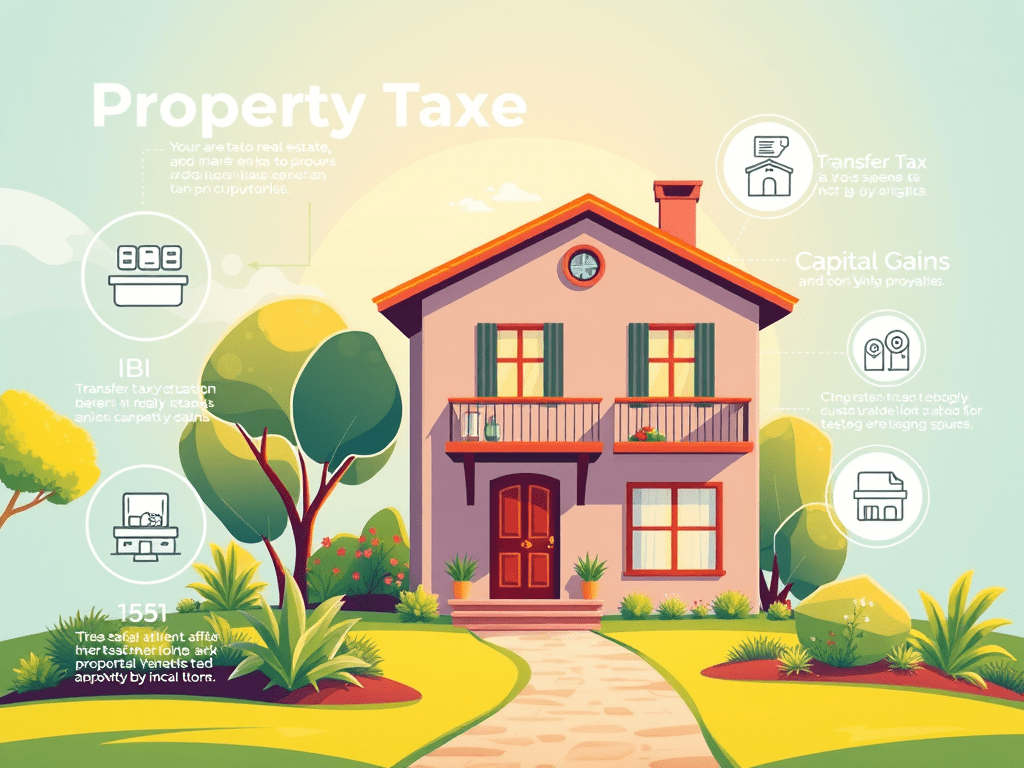
| Tax Type | When / Who | Base / Rate | Notes |
|---|---|---|---|
| IBI (Impuesto sobre Bienes Inmuebles) | Annually, all property owners | ~ 0.3 % to 1.1 % of cadastral value | Local municipal property tax. Applies equally to residents and non-residents. |
| Transfer Tax / VAT / Stamp Duty on Purchase | Upon buying property | 8 % to 11.5 % (for resale or new) | New property often involves VAT; resale involves transfer tax. |
| Capital Gains Tax | On selling property | For non-residents: typically 19 % to 24 % | A 3 % withholding is often held at point of sale as advance on gains tax. |
| Plusvalía Municipal (Municipal Land Value Increase Tax) | On sale of property | Based on increase in assessed land value over time | Local tax, calculated using cadastral land value and years of ownership. |
| Non-Resident Annual Tax / Imputed Income | If property is vacant or owner is non-resident | 1.1 % to 2 % of cadastral value (or lower rate) | Treated as “imputed income” in non-residents. |
| Wealth Tax | For high-value property holdings | Varies by region; exemptions apply | Applies when net assets exceed thresholds (e.g. > €700,000). |
Other points to be aware of:
- The tax rates and rules can vary by autonomous region / municipality.
- The Beckham Law (Régimen fiscal para trabajadores desplazados) may allow certain expatriates to opt for a special tax regime for up to 6 years, altering how their Spanish income is taxed.
- Recently, proposals have emerged for a 100 % tax on purchases by non-EU buyers as a defense against speculative foreign acquisition, though that is still under debate.
- On property sales, the buyer often withholds 3 % of the transaction price as a provisional payment toward the seller’s capital gains tax.
How Dogpay Helps with Real Estate Taxes & Payments
When you buy, own, or sell property in Spain—especially as a foreign investor or non-resident—many payments (deposits, taxes, fees) may cross borders or involve foreign currency. Here’s how Dogpay can add value:
- Transparent Foreigner / Cross-Border Tax Payments When paying transfer taxes, VAT, withholding, or municipal taxes from an overseas account, Dogpay lets you see the precise exchange rate and fees so you know exactly how much arrives in Spain.
- Handling Large Upfront Tax / Fee Payments Buying a property involves large payments: down payment, tax on acquisition, notary, registration. Dogpay helps transfer these efficiently, minimizing hidden bank markups.
- Recurring Annual Taxes (IBI, Wealth, Imputed Income) You’ll need to pay annual taxes like IBI. If your funds are held abroad, Dogpay helps schedule and remit payments reliably.
- Capital Gains / Plusvalía Payment Handling When you sell, you need to settle plusvalía and capital gains taxes. Dogpay can route and document these payments cleanly, ensuring tax authorities receive correct amounts.
- Proof & Audit Trail for Tax Authorities / Compliance Spanish tax offices may request documentation of payments. Dogpay offers exportable logs, receipts, and audit trails that help you meet compliance requirements.
- Budgeting & Currency Risk Control Large tax payments can be vulnerable to exchange rate swings. Dogpay can help lock in favorable rates, or schedule transfers when market conditions are more favorable.